
Skip the over-touristed traps. We analyzed the latest UNESCO inscriptions and global visitor metrics to bring you six stunning, newly crowned World Heritage sites you need to explore before the crowds arrive. ---
The Hook: Why the Map of Global Wonder Just Got Redefined
I stepped out of the dust-caked rental sedan and into the dry, sage-scented wind of the Anatolian steppe. There was no hum of tour buses. No selfie-stick-wielding crowds blocking the horizon. Just the crunch of loose limestone under my boots and the massive, silent presence of the Great Tumulus of Gordion rising like a giant’s earthen shield against the Turkish sky. Standing there, smelling the wild thyme crushed beneath my feet, I realized that the global travel map had just shifted.
Every year, the UNESCO World Heritage Committee meets to crown the world's most irreplaceable cultural and natural treasures. But the recent inscriptions represent something different. According to recent search data and travel flow metrics, today's savvy travelers are actively abandoning over-touristed hubs in favor of "slow travel" destinations that offer raw authenticity.
By cross-referencing UNESCO’s latest additions with regional infrastructure upgrades and search volume trends, we have identified six newly inscribed sites that are highly worth visiting right now. These aren't just historical markers; they are living, breathing landscapes where you can still experience the thrill of genuine discovery.
---
1. Gordion, Turkey: The Realm of King Midas and the Untied Knot
``` ____________________________________________________ / \ | "Go to the Yassıhöyük village museum first; | | the curator has the keys to the wooden chamber | | inside the tumulus—the oldest standing wooden | | structure in the world." | \____________________________________________________/ ```
Located in the wind-swept plains of Central Anatolia, Gordion is the ancient capital of the Phrygian Empire. If the name sounds familiar, it should: this is where Alexander the Great famously sliced through the Gordian Knot, and where the legendary King Midas supposedly turned everything he touched into gold.
What makes Gordion spectacular is its sheer preservation. The site is dominated by massive earthen burial mounds (tumuli). The largest of these, the Tumulus of Midas, contains a perfectly preserved timber burial chamber constructed from pine and juniper logs dating back to 740 BC.
What to Look For
- The Pebble Mosaic: Located in the palace area, this is the oldest known colored pebble mosaic in the world, featuring intricate geometric patterns.
- The Phrygian Gate: The monumental stone gateway to the citadel, featuring massive ashlar masonry that still stands over 10 meters high.
- Pro-Tip: Skip the main visitor path at midday. Arrive at 8:00 AM when the morning light hits the eastern face of the citadel mound. Walk down the narrow, wooden-planked tunnel into the heart of the Midas Mound before any other tourists arrive. The temperature drops instantly, and the smell of 2,800-year-old cedarwood is still faintly discernible in the air.
- Local Culinary Highlight: Stop by the tiny roadside stand run by local villagers just outside the museum gate. Order a fresh gözleme (savory thin dough flatbread) stuffed with wild nettles and sharp, salty sheep's milk cheese, washed down with frothy, salted ayran.
---
2. Koh Ker, Cambodia: The Seven-Tiered Pyramid in the Jungle
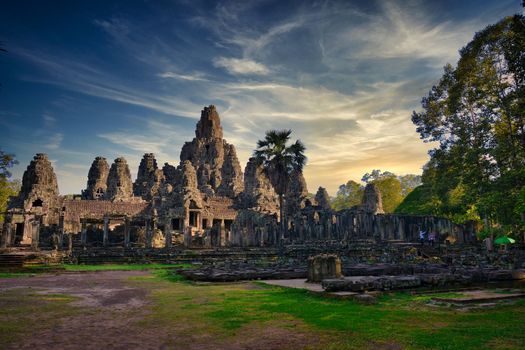
For decades, Angkor Wat has captured the global spotlight. But deep in the northern Cambodian jungle lies Koh Ker, a rival 10th-century capital of the Khmer Empire that was only recently inscribed by UNESCO.
Koh Ker is dominated by Prasat Thom, a stunning 36-meter-tall, seven-tiered sandstone pyramid that looks remarkably like a Mayan temple. Unlike Angkor, where you are corralled along designated boardwalks with thousands of others, Koh Ker offers a raw, Indiana Jones-style exploration. Strangler figs drape over ancient brick towers, and the scent of damp moss and wet laterite stone fills the air.
Key Architectural Marvels
- Prasat Krahom (The Red Temple): Famous for its crumbling red brickwork and the giant stone guardians that once stood watch.
- The Giant Linga Shrines: Massive stone monoliths housed in open-air sanctuaries, half-swallowed by the roots of banyan trees.
- Pro-Tip: Hire a local moto-taxi driver from the nearby village of Srayang to take you to the western side of the reservoir (the Rahal). There is a semi-collapsed, unnamed brick sanctuary where, if you look closely at the door lintel, you can still see faint traces of 1,000-year-old stucco carvings depicting celestial dancers (apsaras).
- Local Culinary Highlight: Stop at a wooden shack along the access road for Khor, a caramelized pork and egg stew infused with local black pepper from neighboring Kampot province.
---
3. The Zagori Cultural Landscape, Greece: Stone Villages and Deep Canyons
When people think of Greece, they picture whitewashed walls and blue domed roofs. But in the rugged Pindus Mountains of Epirus, Zagori offers a completely different aesthetic of slate, limestone, and deep green gorges.
Zagori is a network of 46 stone-built villages (known as Zagorochoria) connected by spectacular arched stone bridges built in the 18th and 19th centuries. The region is home to the Vikos Gorge, one of the deepest canyons in the world relative to its width. The architecture here is defined by viko limestone—slabs of grey stone stacked without mortar to create houses, paths, and walls that blend seamlessly into the mountain cliffs.
Must-See Highlights
- The Kokkoris Bridge: A single-arched stone bridge spanning the Voidomatis River, showcasing master-level Ottoman-era engineering.
- The Skala of Vradeto: A breathtaking stone staircase carved into the side of the Mezaria Gorge, featuring over 1,200 steps.
- Pro-Tip: Avoid the crowded Beloi viewpoint for sunset. Instead, hike the short stone path from the village of Monodendri to the abandoned Monastery of Agia Paraskevi. Walk past the chapel along the narrow cliff-side ledge (hold onto the safety cable) to reach the hidden hermit caves that hang directly over the 1,000-meter drop of the Vikos Gorge.
- Local Culinary Highlight: Order Alevropita at a village taverna. It is a traditional Epirotic thin-batter pie made with flour, eggs, local feta, and butter, baked in a wood-fired oven until blistered and crispy.
---
4. Old Tea Forests of Jingmai Mountain, China: The Birthplace of Pu'er
Deep in the Yunnan province, near the border with Myanmar, lies Jingmai Mountain. This cultural landscape is the world’s oldest artificially cultivated tea forest. For over 1,000 years, the Blang and Dai ethnic groups have cultivated tea trees under the natural forest canopy, creating a unique symbiotic ecosystem.
The air here smells of woodsmoke, damp earth, and the sweet, vegetative aroma of roasting tea leaves. The villages feature traditional two-story wooden stilt houses with gabled roofs decorated with tea-leaf motifs.
Cultural Elements
- Wengji Village: A beautifully preserved Blang minority village where tea leaves are still dried on bamboo mats in the sun.
- The Ancient Tea Groves: Multi-tiered forests where ancient tea trees grow beneath giant banyan and camphor trees, which naturally repel pests.
- Pro-Tip: Wake up at 5:30 AM and walk to the viewing platform at the edge of Nuogan Village. At this hour, a thick, white sea of clouds blankets the valley below, leaving only the wooden rooftops of the village floating like islands in the mist.
- Local Culinary Highlight: Participate in a traditional tea ceremony in a local home. Sip "Moonlight White" (Yue Guang Bai) tea, which is dried strictly under moonlight, giving it a sweet, smooth flavor reminiscent of honey and wild orchids.
---
5. The Historic Town of Si Thep, Thailand: The Forgotten Dvaravati Empire
While tourists flock to Ayutthaya and Sukhothai, Si Thep represents a much older chapter of Thai history. This ancient twin-town site was a major hub of the Dvaravati culture, which flourished from the 6th to the 11th centuries.
The site is divided into an inner town surrounded by a moat and an outer town. The architecture is characterized by massive laterite and brick structures, heavily influenced by Indian Hindu and Buddhist traditions, but executed with a distinct local artistic style.
Key Monuments
- Khao Klang Nok: A colossal, stepped laterite monument that resembles a Buddhist stupa, measuring 64 meters square at its base.
- Khao Klang Nai: Famous for its remarkably preserved stucco reliefs depicting dwarfs, monkeys, and mythical lions decorating the base of the sanctuary.
- Pro-Tip: Rent a bicycle at the visitor center for a few baht. The site is vast and offers very little shade. Ride the dirt path that loops behind Khao Klang Nok to find the quiet, unexcavated mounds where ancient pottery shards still litter the tree roots.
- Local Culinary Highlight: Try Khanom Chin Jakpat, a local fermented rice noodle dish served with a spicy, herb-heavy fish curry sauce that is unique to the Phetchabun province.
---
6. Gede Ruins, Kenya: The Ghost City of the Swahili Coast
Hidden within the lush Arabuko-Sokoke Forest near the coastal town of Watamu lie the Gede Ruins. This medieval Swahili-Arab city was founded in the 12th century and mysteriously abandoned in the 17th century.
Built entirely from coral-rag stone and lime plaster made from burnt seashells, Gede was a highly advanced city with piped water, flushing toilets, and stone palaces. Today, giant baobab trees grow through the walls of the Great Mosque, and playful Sykes' monkeys swing from the vines overhead.
Architectural Features
- The Palace: A sprawling complex of sunken courtyards, arched doorways, and private residential quarters.
- The Tomb of the Fluted Pillar: A unique Swahili funerary monument featuring a striking octagonal pillar.
- Pro-Tip: Do not hire the generic guides at the main gate. Instead, ask for one of the local community guides who specialize in the forest's ecology. They can point out the rare golden-rumped elephant shrews hiding in the undergrowth of the ruins and explain how the Swahili builders used local plant sap to reinforce their coral mortar.
- Local Culinary Highlight: Head to nearby Watamu after your visit and try Mshikaki (skewered, marinated beef cooked over charcoal) served with fresh coconut rice and mango chutney.
---
Logistics, Budget, & Planning Matrix
To help you turn this inspiration into reality, we have compiled the essential data for planning your journey to these newly crowned wonders.
| Destination | Best Time to Visit | Est. Daily Budget (USD) | Primary Transit Hub | How to Get There | | :--- | :--- | :--- | :--- | :--- | | Gordion, Turkey | Sept–Nov & Apr–May | $45 - $60 | Ankara (ESB) | Take a regional train from Ankara to Polatlı, then hire a local taxi for the remaining 15km to Yassıhöyük. | | Koh Ker, Cambodia | Nov–Feb | $65 - $80 | Siem Reap (SAI) | Hire a private driver or join a small-group 4WD tour from Siem Reap (approx. 2 hours each way). | | Zagori, Greece | May–Oct | $90 - $120 | Ioannina (IOA) | Fly to Ioannina, rent a 4x4 vehicle (essential for mountain switchbacks), and drive 45 mins north. | | Jingmai Mountain, China | Mar–May (Tea Harvest) | $55 - $75 | Lancang (JMJ) | Fly to Lancang Jingmai Airport, then hire a local driver or take the scenic mountain bus up to Wengji. | | Si Thep, Thailand | Nov–Feb | $35 - $50 | Bangkok (BKK) | Take a northern-line bus from Bangkok's Mochit Terminal to Phetchabun, alighting at the Si Thep junction. | | Gede Ruins, Kenya | Jun–Oct | $80 - $100 | Malindi (MYD) | Fly to Malindi, then take a 20-minute matatu (local minibus) or private tuk-tuk south to Gede village. |
---
Traveling Responsibly in the New Era of Heritage
These sites have been preserved for centuries by local communities, geography, or sheer isolation. Their new UNESCO status will inevitably bring increased visitor numbers. As travelers, our goal should be to minimize our footprint while maximizing our positive economic impact on the local communities.
When visiting these sites, hire local guides, stay in family-run guesthouses, buy handicrafts directly from artisans, and respect the integrity of the ruins. By choosing these lesser-known wonders, you are not only securing a more authentic travel experience for yourself—you are also helping to distribute tourism revenue to communities that truly benefit from it.
---
More pictures

Tags
Share this guide
We may earn a commission if you click a link and buy a product or service, at no extra cost to you. How affiliate links work.
Been there?