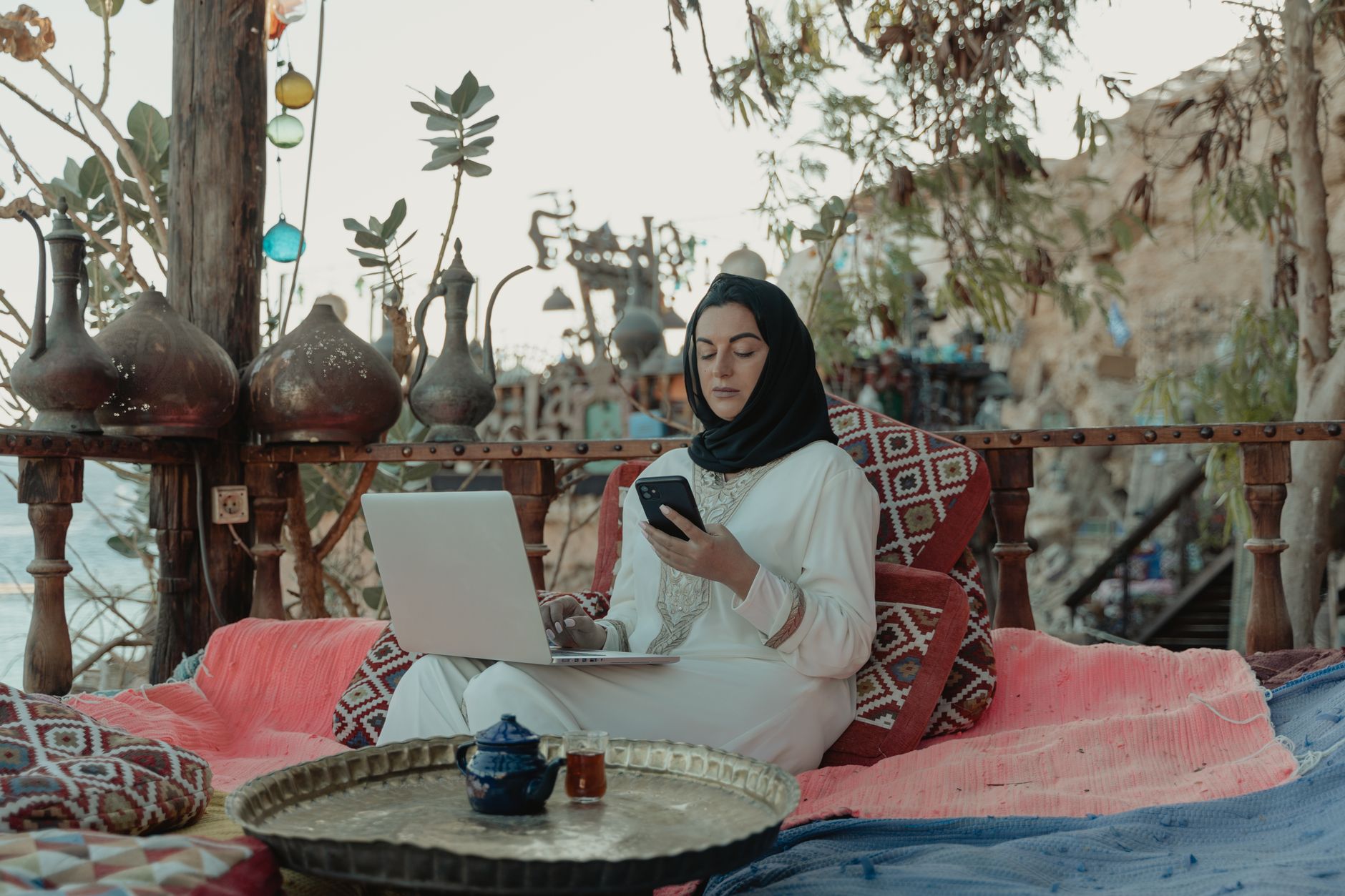
Forget crowded co-working spaces and noisy tourist cafes. Imagine tapping away at your laptop in a bustling local market, a serene hidden courtyard, or a quaint family-run bakery. This guide reveals how to set up your mobile office in places only locals know, offering an unparalleled blend of productivity and authentic cultural immersion. ---
The aroma of freshly brewed coffee mingled with the earthy scent of damp soil after a morning shower. A distant motorbike rumbled, punctuated by the cheerful chatter of a grandmother haggling over mangosteens. I was hunched over my laptop, a half-empty glass of kopi susu sweating beside me, in a tiny warung tucked away down a narrow alley in Ubud, Bali. No other foreigners in sight, just locals going about their day. This wasn't a trendy café, nor a sterile co-working space. This was my office for the day – a place so authentically Balinese, I felt like I'd stumbled into a secret.
For years, my digital nomad journey felt like a constant battle between finding a quiet corner to focus and truly experiencing the soul of a place. I'd bounce from overpriced, generic co-working spaces to bustling cafes filled with other laptop warriors, always feeling a slight disconnect. It was efficient, yes, but was it authentic? Was I truly immersing myself, or just recreating my home office abroad?
Then came the epiphany, born out of necessity and a desire for something more: the "local office." These aren't places advertised on Google Maps for "best remote work spots." These are the tucked-away bakeries, the quiet community libraries, the unassuming tea houses, or even just a perfectly placed park bench where locals gather, relax, and occasionally, work. They’re the spots that tourists, by and large, simply don't know exist, or wouldn't think to utilize. And unlocking them? That's where the magic truly happens. You get unparalleled focus, a deeper cultural connection, and a story far more interesting than "I worked from a Starbucks in Rome."
Ready to ditch the tourist traps and truly integrate your work life with authentic local experiences? Let's dive in.
Why Go Local? The Unsung Benefits of Your Secret Office
The allure of the local office goes far beyond just a good Instagram shot (though you'll get plenty of those). It's about transforming your travel and work experience.
- Authenticity on Tap: This is the big one. When you work where locals work, you're not just observing, you're participating. You'll hear the local language, witness daily routines, and soak in the true rhythm of a place. It's a living, breathing backdrop to your workday that no curated co-working space can replicate.
- Cost Savings That Add Up: Let's be real, tourist-centric places often come with a "foreigner tax." A coffee that costs $5 in a trendy expat café might be $1 at a local panadería. Lunch? Forget $15; think $3 for a delicious, home-cooked meal. Over weeks or months, these savings are substantial.
- Unique Atmosphere & Inspiration: The clatter of espresso machines, the scent of fresh bread, the murmur of conversations in an unfamiliar tongue – these aren't distractions; they're inspiration. Your senses are engaged, sparking creativity and making even mundane tasks feel more vibrant.
- Escape the Digital Nomad Bubble: While connection with fellow nomads is great, it’s easy to get stuck in a bubble. Working locally forces you out of it, broadening your perspective and pushing you to engage with the culture around you.
- Productivity in Disguise: Surprisingly, these seemingly chaotic environments can foster incredible focus. The novelty, the subtle pressure to blend in, and the lack of familiar distractions can lead to deep work sessions. Plus, the quiet moments are truly quiet, often more so than a bustling co-working space.
The Art of Blending In: Pre-Requisites for Your Secret Office
Before you even think about scouting locations, you need to cultivate the right mindset and equip yourself appropriately. This isn’t about being sneaky; it's about being respectful, prepared, and inconspicuous.
1. Research & Respect: Your Cultural Compass
The phrase "locals don't want tourists to know" isn't about hostility; it's about preserving a certain peace, a certain way of life. Your goal isn't to invade, but to integrate respectfully.
- Learn Basic Phrases: "Hello," "thank you," "please," "coffee," "water," "bill" – these are your golden tickets. A genuine attempt to speak the local language, no matter how clumsy, goes a long way in breaking down barriers and earning goodwill.
- Observe & Adapt: Pay attention to local customs. How do people dress? What are the typical meal times? Is it customary to linger, or to eat and leave? Are certain gestures considered rude? A quick Google search for "cultural etiquette in [country]" is a great starting point.
- Dress the Part (or Close Enough): You don't need to completely overhaul your wardrobe, but dressing modestly and comfortably, aligning with local norms, will help you blend in and avoid unwanted attention. In many parts of the world, this means covering shoulders and knees.
- Support Local Businesses: Your presence should be a benefit, not a burden. Be a good customer.
2. Gear Up Smart: Your Portable Arsenal
Your mobile office needs to be just that – mobile. Minimalism and efficiency are key.
- Portable Power Banks: Essential. A high-capacity power bank (20,000mAh or more, like an Anker PowerCore) can give your laptop an extra few hours and keep your phone charged all day.
- Universal Travel Adapter: Don't get caught without the right plug. A multi-country adapter is a must-have.
- Reliable Internet Solution:
- Local SIM Card: Your absolute best friend. Upon arrival, grab a local SIM with a generous data plan. Providers like AIS in Thailand, Claro in Colombia, or Vodacom in South Africa offer excellent coverage and affordable packages. This is often faster and more reliable than public Wi-Fi.
- Portable Wi-Fi Hotspot (Optional but Recommended): If you're working on multiple devices or need a backup, a dedicated portable hotspot (like a Huawei MiFi) with your local SIM can be a lifesaver.
- Noise-Cancelling Headphones: For those moments when the local charm gets a little too charming, a good pair of noise-cancelling headphones (Bose QC series or Sony WH-1000XM series) can create your personal bubble of focus.
- Compact Ergonomic Setup: A foldable laptop stand, a small wireless mouse, and perhaps a compact Bluetooth keyboard can save your neck and wrists without taking up much space.
- Security Lock: A small Kensington lock can secure your laptop to a table if you need to step away for a moment (though use discretion in very local spots – sometimes it draws more attention than it deters).
Scouting Your Sanctuary: Where Locals Actually Work (and Play)
This is where the adventure begins. You’re not looking for "digital nomad friendly," you're looking for "life friendly."
1. The Humble Local Café or Bakery (Panadería, Warung Kopi, Pastelería)
- What to Look For: Avoid anything with "Artisan," "Espresso Bar," or English menus prominently displayed. Seek out places with older locals nursing small cups of coffee, reading newspapers, or chatting quietly. Look for worn furniture, local pastries, and a distinct lack of power outlets (which means fewer laptop users!).
- My Anecdote: In Medellín, Colombia, I found my sanctuary in a tiny panadería called "El Trigal." It was always bustling with grandfathers playing dominoes, women picking up fresh bread, and the rich scent of tinto (black coffee). I'd order a pan de queso and a small tinto for less than $2, set up my laptop discreetly in a corner, and work for hours using my Claro SIM. The staff, initially curious, soon became accustomed to "the gringo with the computer," and would greet me with a warm "¡Hola, amigo!" every morning.
- Tips: Don't hog a large table. Order frequently (a coffee every hour or two). Be mindful of peak hours when space is truly needed by paying customers. If they don't have Wi-Fi, excellent! That means fewer digital nomads.
2. Public Libraries & Community Centers
- What to Look For: These are often overlooked by tourists but are goldmines for quiet, free, and often air-conditioned spaces with reliable Wi-Fi. Many have dedicated study areas.
- My Anecdote: In Tbilisi, Georgia, after struggling with inconsistent Wi-Fi in my Airbnb, I discovered the National Parliamentary Library. It was a grand, quiet building with strong internet, and best of all, free to use. I'd spend entire afternoons there, surrounded by local students and researchers, feeling like a true academic. The silence was profound, a stark contrast to the city's lively streets.
- Tips: Check their hours. Be extra respectful of silence rules. Some might require a temporary visitor pass, which is usually easy to obtain.
3. Hidden Courtyards, Parks, and Riverside Benches
- What to Look For: Not the main tourist parks, but smaller, neighborhood green spaces, public squares, or even the courtyards of lesser-known museums or guesthouses that allow visitors to linger. Look for benches under shade, ideally near a discreet power outlet (a rare find, but worth hunting for!), or where your portable power bank can shine.
- My Anecdote: In Hoi An, Vietnam, I found a beautiful, shaded courtyard behind an old tailor shop. It wasn't officially a café, but they served simple iced coffees. I'd sit on a stone bench, the sounds of sewing machines humming in the background, and work for hours, feeling the gentle breeze and watching the occasional local pass through. The internet was my own mobile hotspot, and the power was my trusty Anker. The owners eventually started offering me small plates of fruit.
- Tips: This is where your mobile data and power bank are non-negotiable. Be aware of your surroundings and keep your gear secure. Natural light is great, but direct sun can make screen visibility difficult.
4. Unassuming Local Eateries (Comedores, Warungs, Trattorias)
- What to Look For: Places that serve simple, affordable, local food and are bustling during lunch hours but might have quieter periods. Often, these are family-run businesses.
- My Anecdote: In a small town outside Chiang Mai, Thailand, I found a khao soi stand that expanded into a small, covered eating area. After the lunch rush, it would empty out, leaving just a few locals chatting. I'd order a second bowl of khao soi (for about $1.50) and discreetly open my laptop. The owner’s daughter, who spoke a little English, was fascinated by my work and would sometimes bring me extra water. It was a taste of real Thai life, right alongside my spreadsheets.
- Tips: The key here is timing. Avoid peak meal times. Order a good amount of food to justify your stay. Don't expect Wi-Fi; rely on your local SIM.
Mastering the "Local Office" Etiquette
Finding these spots is only half the battle. Maintaining them as viable workspaces requires thoughtful engagement.
- Be a Patron, Not a Parasite: This is paramount. If you're using a café, buy drinks and food regularly. Don't just order one coffee and nurse it for six hours. Your presence should contribute to their business, not detract from it by occupying a table that could be used by a higher-spending customer.
- Minimize Your Footprint: Your mobile office should be just that – mobile and minimal. Don't spread out your gear across an entire table. Keep your laptop, mouse, and perhaps a notebook contained to a small, unobtrusive space. Avoid loud typing or taking calls without headphones.
- Observe & Adapt: Pay attention to the local pace. If everyone is quietly reading or chatting softly, don't be the loud foreigner. If it's a bustling, energetic place, a little more background noise might be acceptable. Learn when quiet hours are, and when it’s okay to be a bit more social.
- The Power of a Smile & Basic Phrases: A genuine smile and a simple "thank you" in the local language can open doors. Locals appreciate the effort. You might even find yourself striking up a conversation, leading to even deeper insights into the culture.
- Don't Expect Wi-Fi: Seriously. This mindset shift is crucial. Assume there won't be Wi-Fi and be pleasantly surprised if there is. Your local SIM card is your primary internet source.
- Be Prepared for Curiosity: Especially in less touristy areas, your laptop might attract attention. Be open to a friendly glance or even a simple question. A simple explanation of what you're doing (e.g., "trabajo" in Spanish, "kerja" in Indonesian) often suffices.
Navigating the Nitty-Gritty: Connectivity, Power, and Comfort
Even with the perfect spot, practicalities can make or break your workday.
1. Internet Solutions: Your Digital Lifeline
- Local SIM is King: I cannot stress this enough. Upon arrival in any new country, make getting a local SIM card with ample data your top priority. Research providers beforehand (e.g., AIS in Thailand, Claro/Tigo in Colombia, Vodafone/Orange in Europe, Jio in India). They're usually cheap, reliable, and offer excellent coverage.
- Tethering is Your Friend: Use your phone as a personal hotspot for your laptop. Most modern smartphones handle this seamlessly.
- VPN for Security: When you do connect to public Wi-Fi (even if it's a local café's), always use a Virtual Private Network (VPN) to encrypt your data and protect your privacy. NordVPN or ExpressVPN are popular choices.
2. Power Play: Keeping Juiced Up
- Power Bank Discipline: Get into the habit of charging your power bank every night, just like your phone. It’s your backup, and often your primary, power source.
- Scout for Outlets (Discreetly): In a local café, an outlet might be a rare find. If you spot one, politely ask if you can use it. Don't just unplug something else! If it's busy, consider if it's really appropriate to monopolize an outlet.
- Battery Management: Adjust your laptop settings for power efficiency. Dim your screen, close unnecessary apps, and use battery-saver modes.
3. Ergonomics on the Go: Your Body Will Thank You
- Compact Stands: A foldable laptop stand (like the Roost stand or similar portable options) can elevate your screen to eye level, saving your neck.
- External Mouse/Keyboard: If space allows, a small wireless mouse and a compact Bluetooth keyboard can make a world of difference for long work sessions.
- Frequent Breaks: Regardless of your setup, take regular breaks. Stand up, stretch, walk around. Grab another coffee, or simply observe the world around you. This is one of the joys of the local office!
4. Safety & Security: Keeping Your Wits About You
- Situational Awareness: Always be aware of your surroundings. Don't leave your laptop unattended, even for a moment. If you need to use the restroom, pack up your gear or ask a trusted local (if you've built rapport) to watch it.
- Blend, Don't Flash: Avoid overtly displaying expensive gear. Keep your setup compact and don't draw unnecessary attention to yourself.
- Digital Security: Beyond a VPN, ensure your devices are password-protected and backed up regularly.
Conclusion: Your World, Your Office
Setting up your mobile office in places only locals know isn't just a productivity hack; it's a philosophy. It's about shedding the tourist facade, embracing the unknown, and truly connecting with the heart of a destination. It challenges you to be more adaptable, more respectful, and more present.
The next time you're on the road, instead of defaulting to the familiar, take a detour. Wander down that intriguing alley, step into that unassuming eatery, or explore that quiet neighborhood park. With a little preparation, a lot of respect, and an open mind, you'll discover a world of authentic workspaces that will not only boost your productivity but enrich your travel experience in ways you never imagined.
So, go forth, explore, and let us know: where's the most unexpected local spot you've ever set up your office? Share your stories and inspire others to work smarter and travel deeper!
---
More pictures



Tags
Share this guide
We may earn a commission if you click a link and buy a product or service, at no extra cost to you. How affiliate links work.
Been there?